The flag has a very ancient history. We find evidence of it being used as a military symbol by the Assyrians and Babylonians, and also by Alexander the Great, whose army bore a purple banner as its emblem (4th century BC). With the rise of Roman civilization, distinctive standards identifying the various units appeared, alongside emblems depicting animals or sacred objects. These standards consisted of a red square of cloth attached to the top of a pole by means of a crossbar beneath the tip—what we would today call banners or gonfalons. Strips of cloth or colored drapes, hoisted on poles and called bands, in imitation of the Roman standards, gradually appeared also among barbarian armies, particularly the Lombards. From them, the use of the flag became common practice in civil society as well, serving as a means of communication and as a marker of authority and noble families.


The flag in history
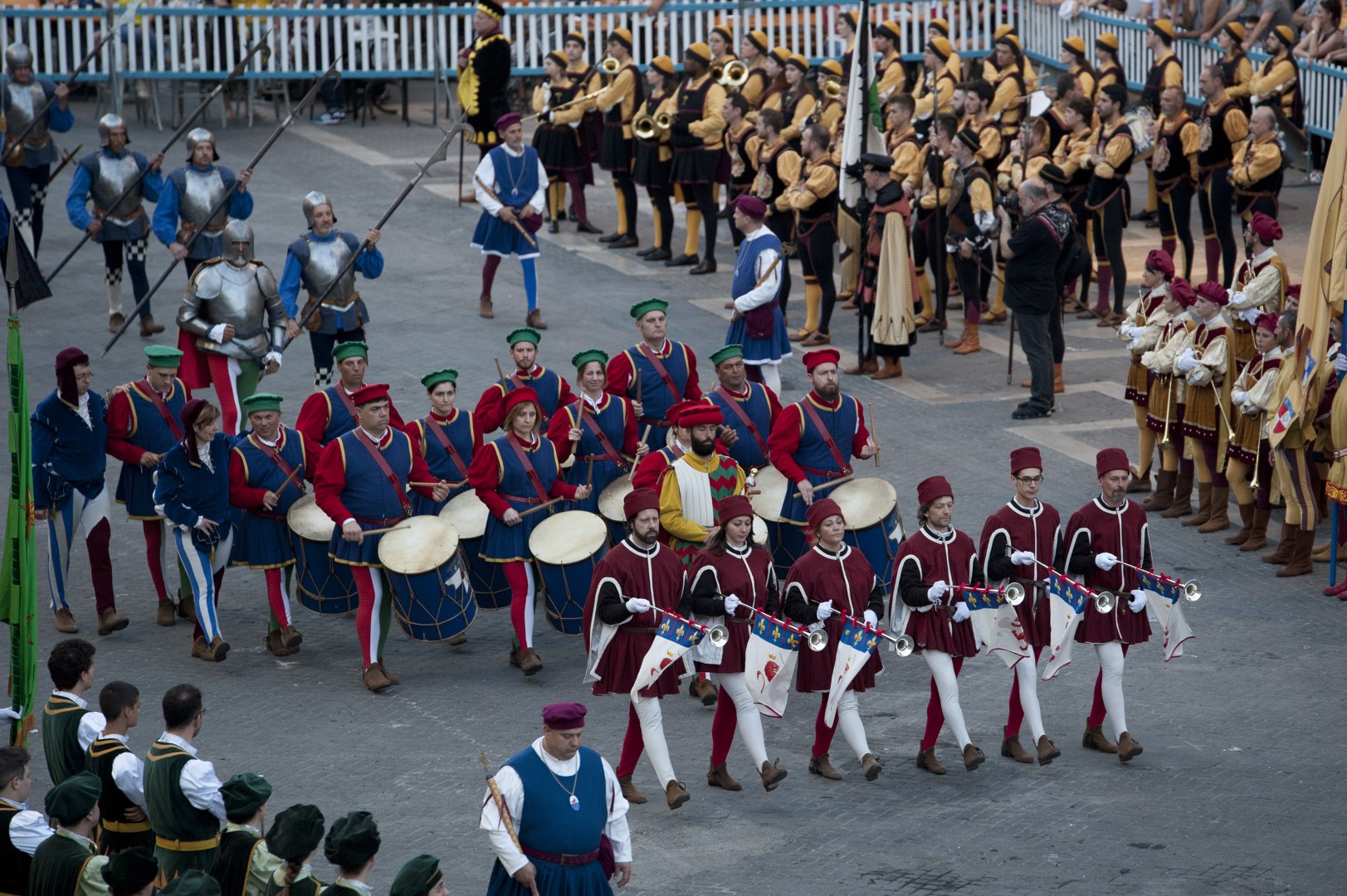
Widely used in the military sphere as a means of signaling, flags also became essential in civic life to represent noble families and the guilds of arts and crafts, as well as civil authorities. Contacts with non-Christian territories, brought about by the Crusades, influenced the development of heraldry, further enriching the symbolic meaning of the flag, which also came to represent the civic identity of the city. In this sense, during the modern Niballo parade we find the flag of Faenza—namely the gonfalon—marching with the Municipal Group, along with a multitude of banners and standards: from the guild of bakers to the noble families of the different districts, as well as the emblems of the fortresses surrounding Faenza.
As the importance of the flag grew, so did the prestige of those who carried it—the standard-bearers (from the Arabic al-faris, meaning knight or horseman). To the strength and courage they were expected to show in battle was added the grace and skill of flag-waving during tournaments or on other significant occasions, such as the knighting ceremonies. An interesting episode took place in Faenza in 1080, when the Count of Vitry (still remembered today in the street that bears his name) came to the aid of the people of Faenza, who were fighting against the Ravennati, and managed to put them to flight. As a token of gratitude, the Count requested that every year on May 1st his two standards be carried into the church of San Sigismondo. From then until 1796, two young noblemen would carry the Count’s standards, skillfully spinning them through the city streets. In the late 1990s, for a few years, the Yellow District (Rione Giallo) revived this ancient custom.
Between Folklore and Decoration
With the end of the Middle Ages and the beginning of the Modern Era, particularly between the 17th and 18th centuries, the flag took on an increasingly folkloric and decorative role, especially in times of peace. In artistic representations as well, standard-bearers began to abandon their rigid military stance in favor of elegant, almost circus-like poses. Alongside equestrian jousts, tournaments of pike and flag emerged, in which the standard-bearer—often a young nobleman at this time—displayed his skill and dexterity, while the connection to the military sphere grew ever weaker. The flag-bearer also became an entertainer, brandishing the banners of popes, cities, and armies during popular festivities, moving closer to the figure of the modern juggler and to today’s sbandieratore.
In 1674, the Accademia dei Remoti was founded in Faenza by Count Michele Spada. One of the activities of its members was “playing with swords and with flags,” a sign that flag-waving was by then perceived as a form of play: the violence of the battlefield was only represented in the movements, but in reality was absent. Flag-waving had become a pastime, and the flag-bearers were enthusiasts who divided their passion between fencing and the flag. This trend is further confirmed by the appearance of actual manuals on the art of the flag. One such example is the beautiful New Kunstlich Fahnenbüchlein by Johann Renner and Sebastian Heubler, first printed in Nuremberg in 1615. In this book we find illustrations and explanations on how to perform exercises with the flag, and the volume is very similar to La Bandiera, published in 1638 by Francesco Ferdinando Alfieri, master of arms of the Most Illustrious Accademia Delia in Padua.
The art of fag play
As the decades passed, the game of the flag gradually lost importance, surviving only in a few palii or on special occasions. With the arrival of the 20th century and the growing fascination with the medieval period, the flag-bearer and the game of the flag returned to prominence together with the first historical reenactments. Flag-waving groups began to appear all over, reviving ancient traditions and distinguishing themselves with movements and techniques that varied from city to city. With the economic boom of the post-war years and the rise of mass tourism, the flag-bearer was called upon not only for historical reenactments but also for spectacular, choreographed performances outside a strictly historical context—shows that often brought Italian flag-wavers around the world. For instance, within thirty years the Gruppo Alfieri Bandieranti e Musici di Faenza traveled through many European countries, even performing at the European Parliament on the occasion of Faenza’s victory of the Premio Europa. This spectacular soul and enduring charm are what the game of the flag has preserved over time. Yet in recent years, it has been joined by an increasingly strong competitive spirit. In many Italian groups, including those of Faenza, performers have moved away from traditional flag-waving—with wooden poles and hand-painted cloths—towards a competitive style, with contests, judges, regulations, carbon fiber flags, and increasingly simplified costumes.
Today, the game of the flag finds itself with two distinct, and at times competing, souls. It will be interesting to see how it evolves in the coming years, but of one thing we can be certain: the fascination of the flags will remain unchanged.
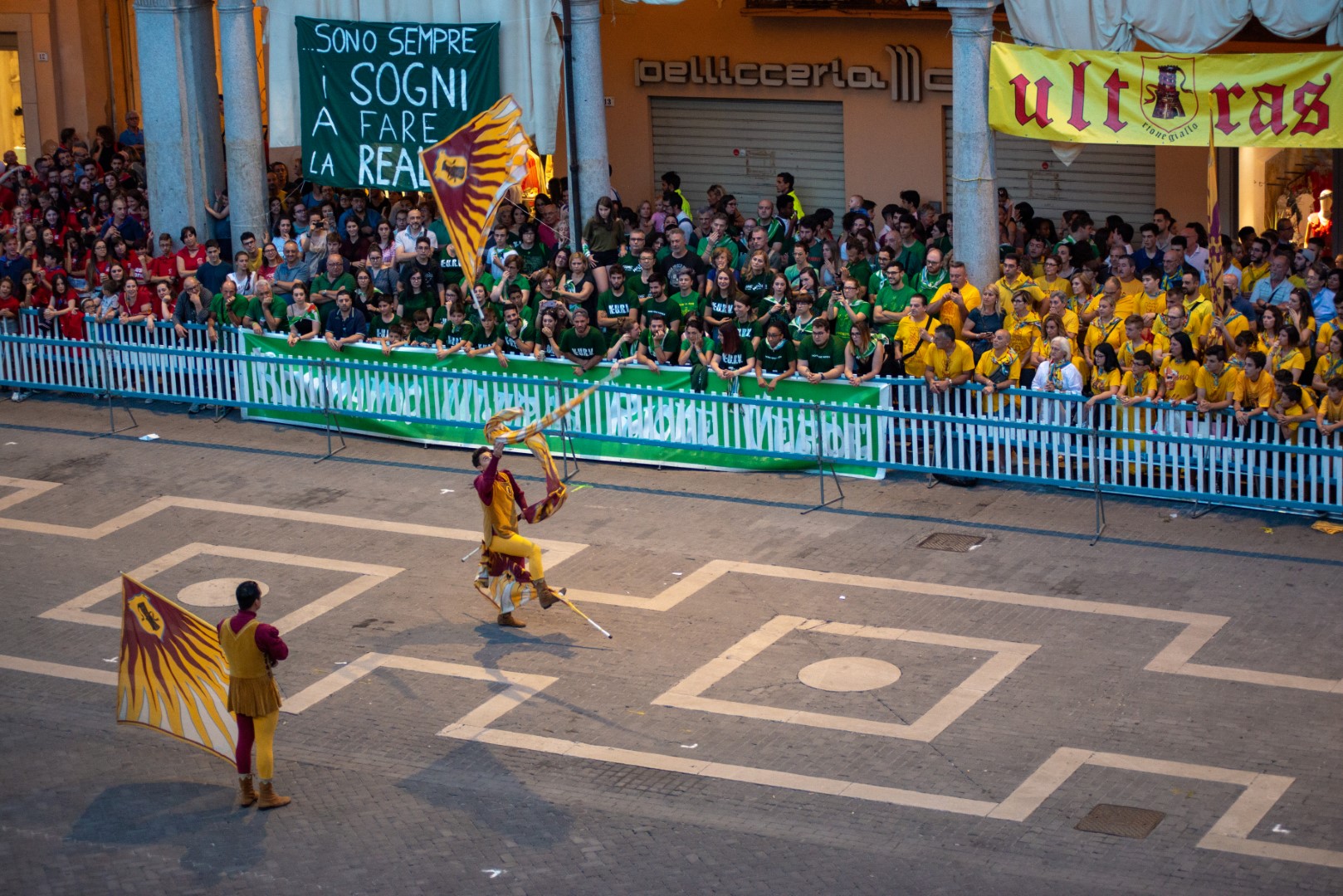
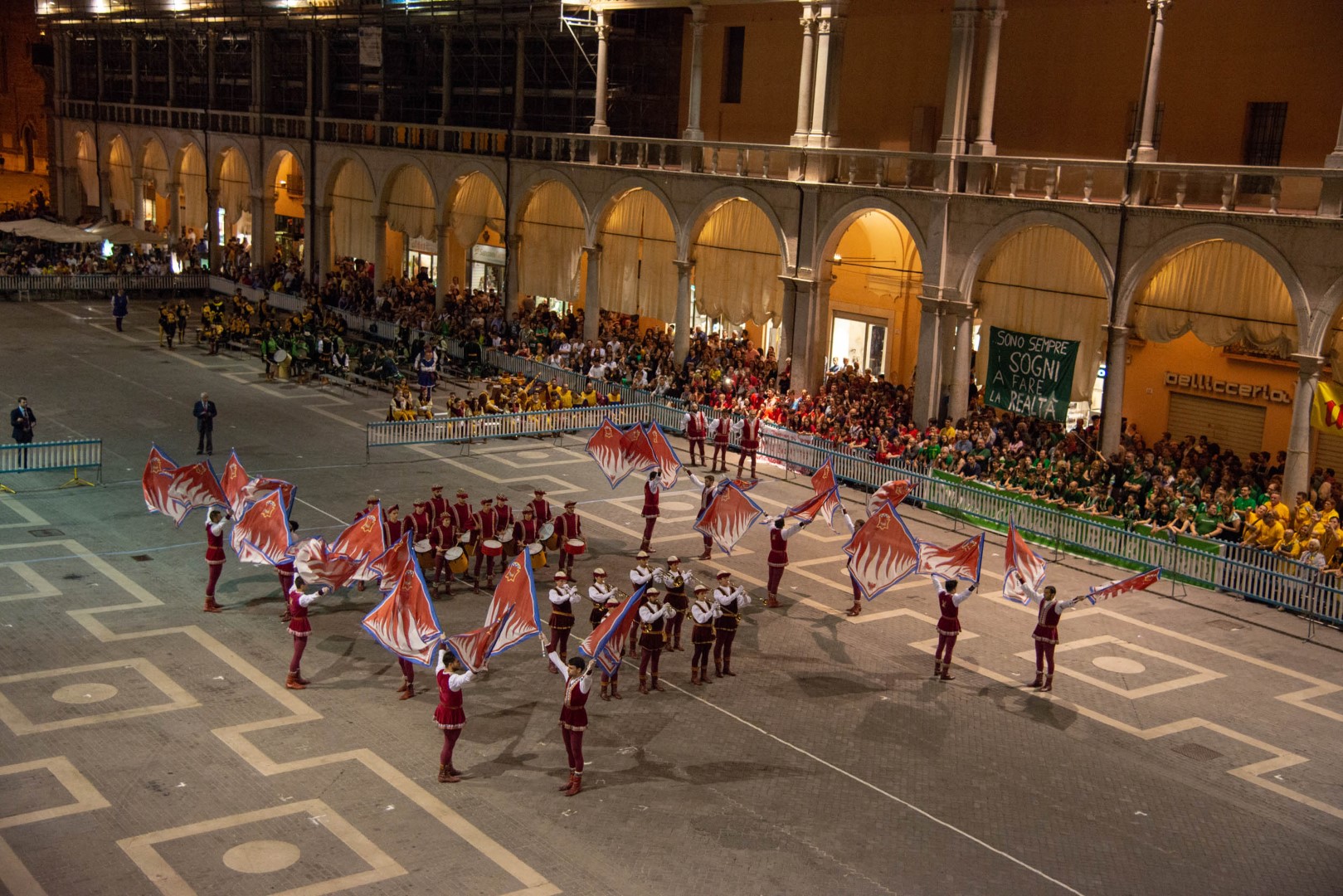
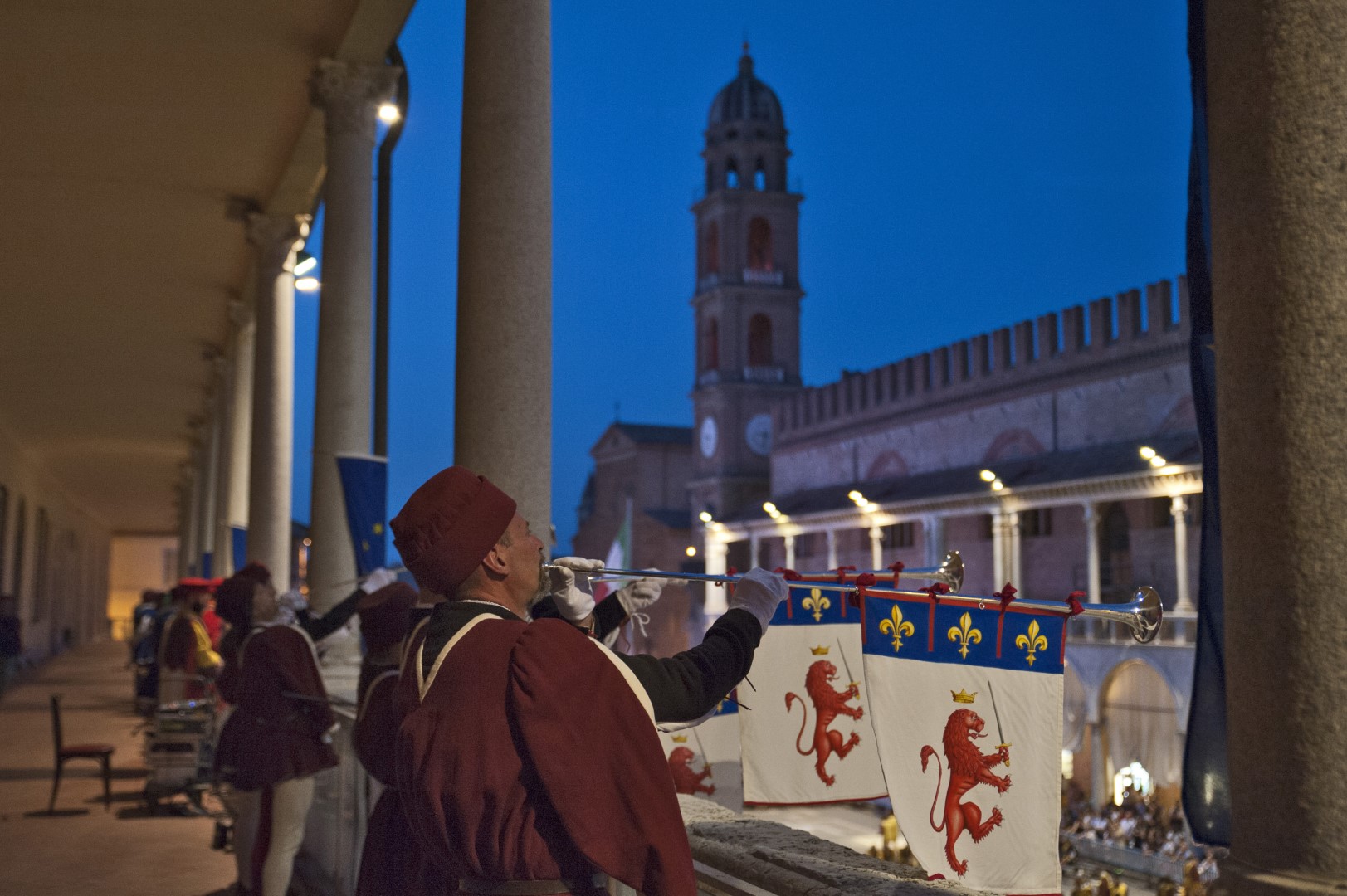
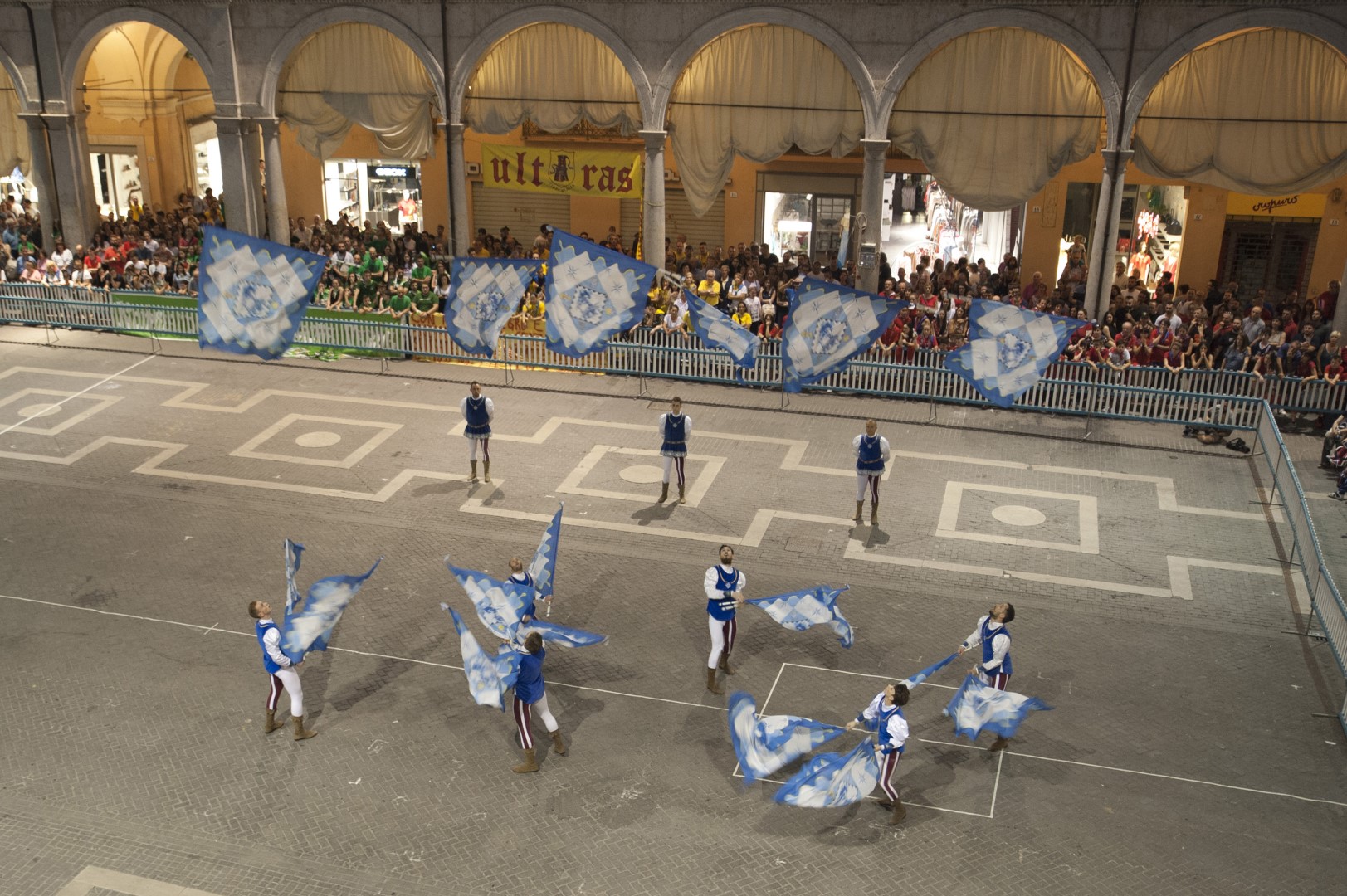
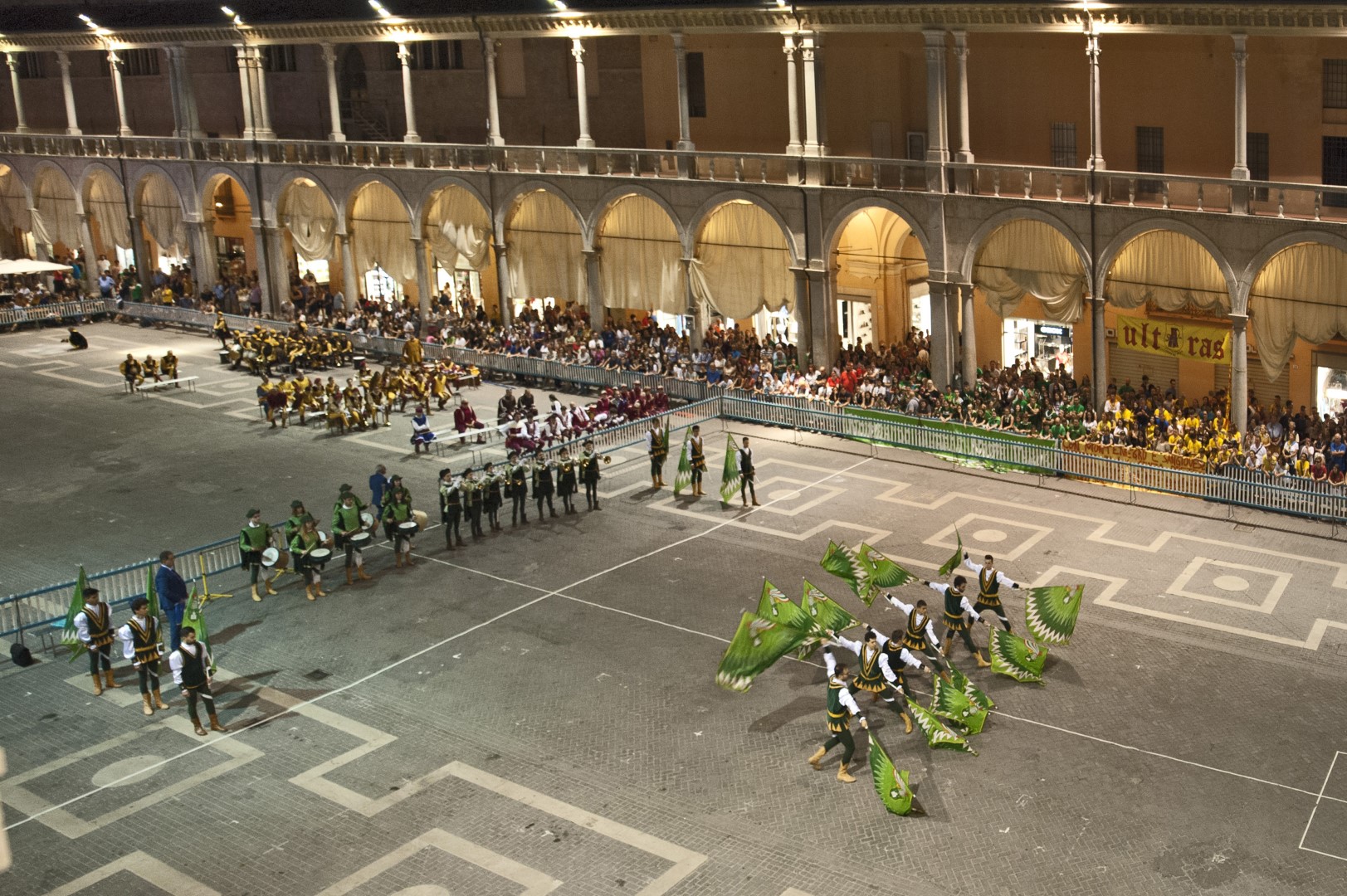
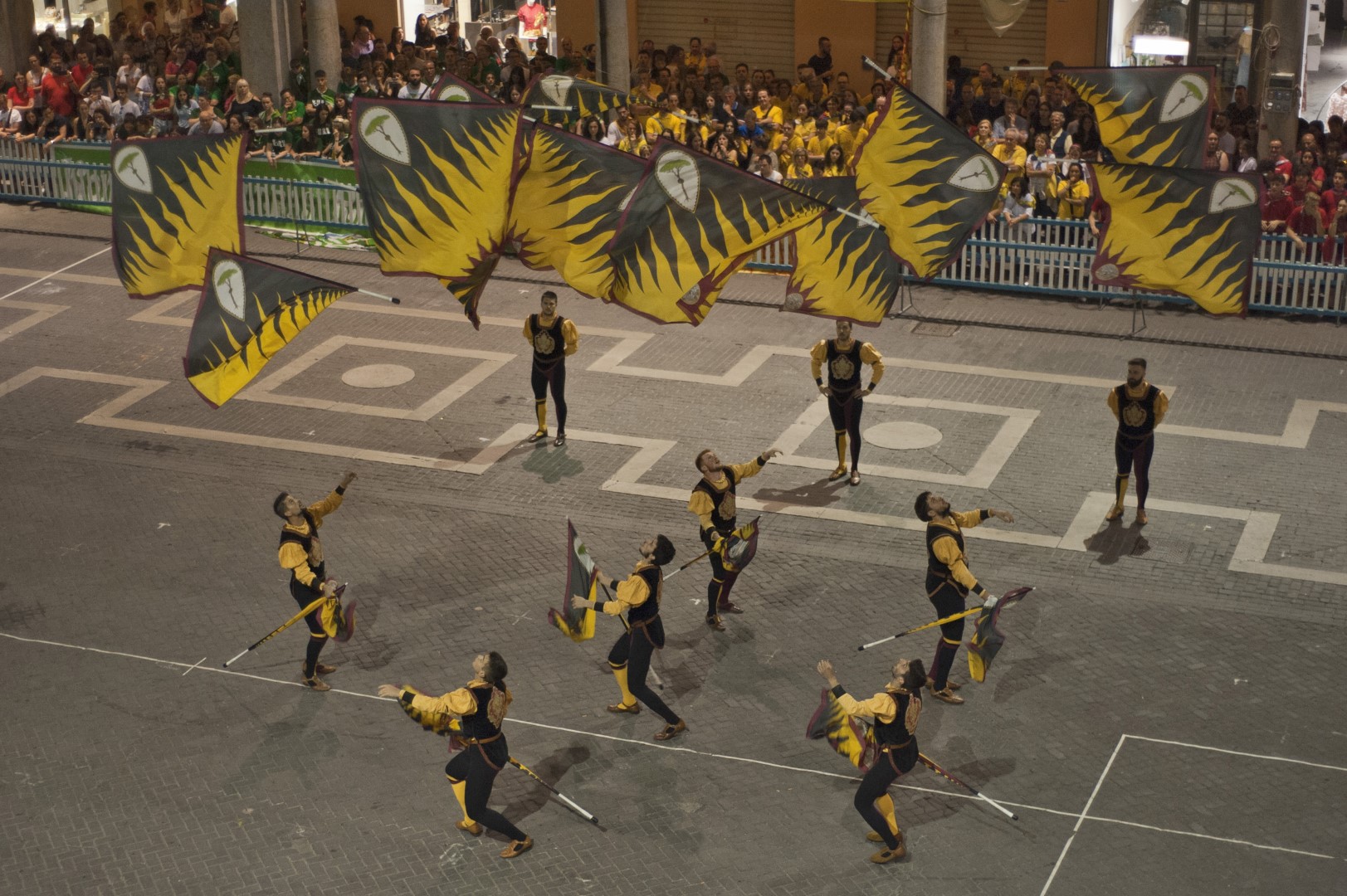
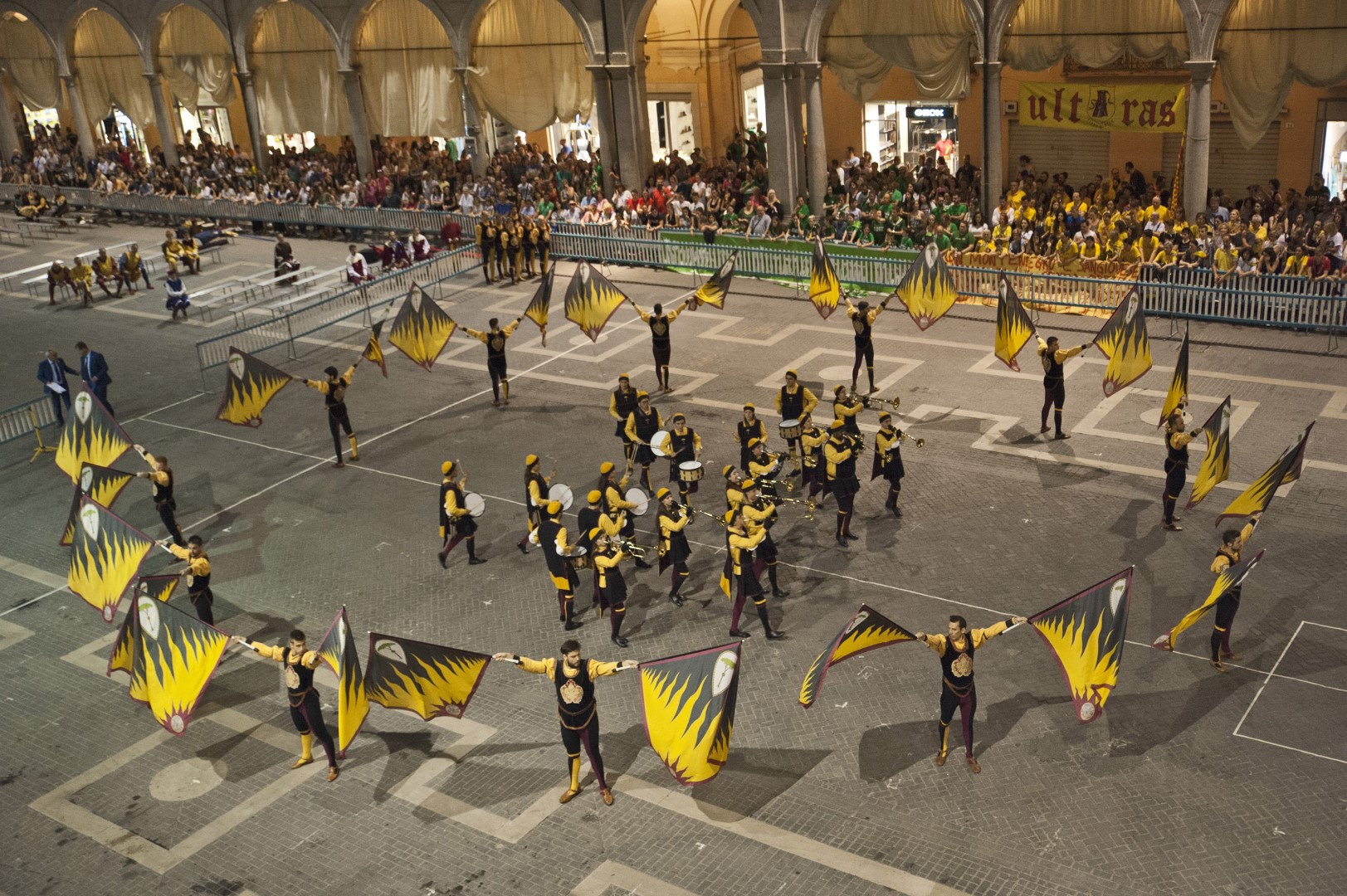
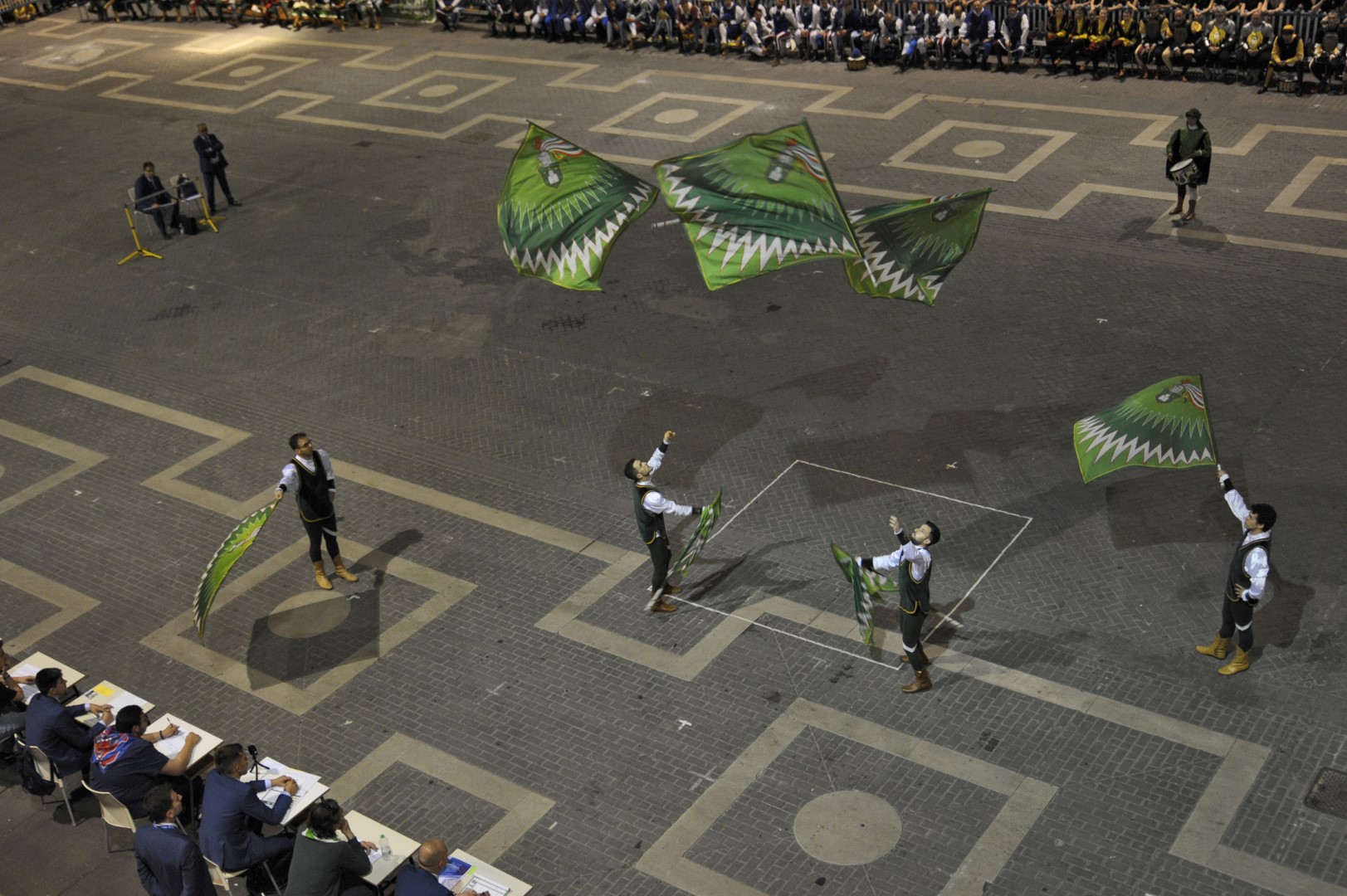
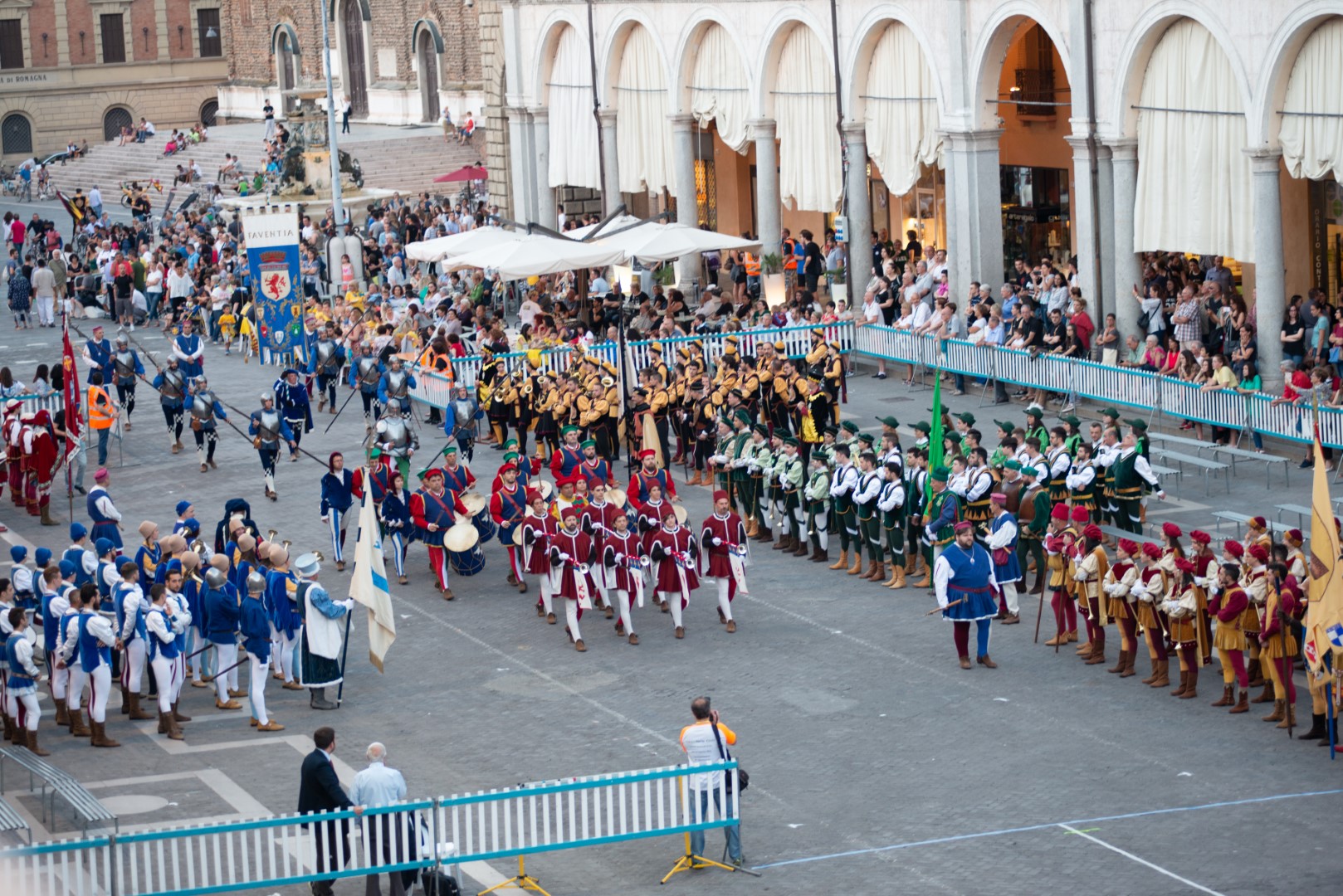
In Faenza, according to tradition, on the evening of the third Saturday in June the “Tournament of Flag-Wavers and Musicians” takes place, featuring the specialties of “Single,” “Small Team,” and “Large Team with Musicians.” Polychrome banners bearing the emblems of the Rioni whirl through the night sky with extraordinary synchrony, accompanied by the powerful roll of drums and the ancient sound of clarions, in the enchanting setting of the illuminated palaces and loggias of Piazza del Popolo, framed by figures in arms.
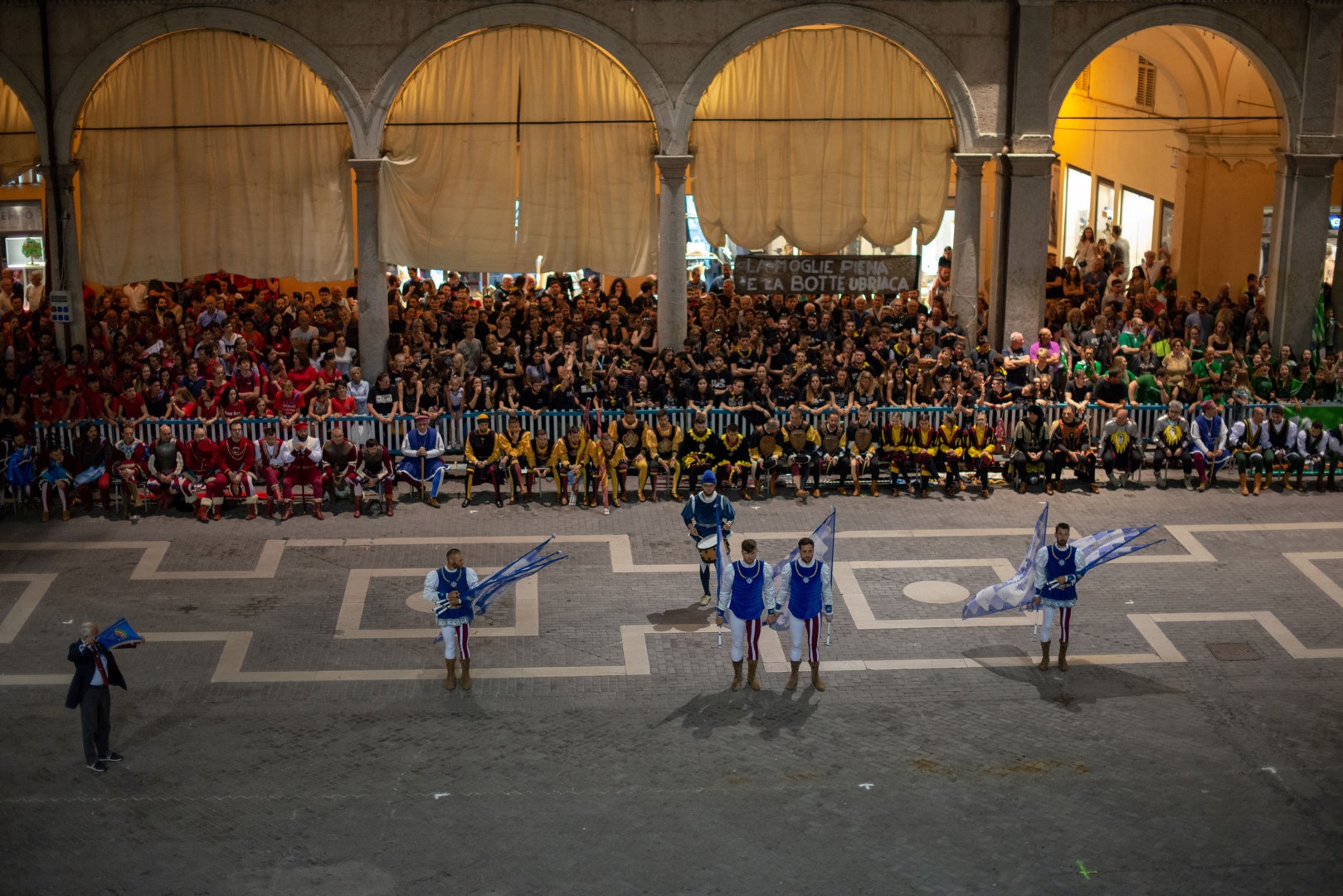
On the following evening, Sunday—one week before the running of the Palio del Niballo—the Knights who will compete in the Palio swear an oath in Piazza del Popolo, before the Podestà of the Joust, the Maestro di Campo, and the entire city, to uphold the rules of Chivalry and to fight loyally for the colors of their own Rione. After this solemn ceremony, the most traditional of the tournament’s contests takes place: the competition among the flag-wavers of the five Rioni in the classic “Couple” specialty, which awards the winning Rione a great cask of wine to be enjoyed in celebration late into the night. Thanks to their recognized skill, the flag-wavers of Faenza’s five Rioni have repeatedly distinguished themselves as champions in national and international competitions, even winning the title of World Champions in the single and couple categories and earning highly honorable placements in other specialties—thus placing the Faenza School at the pinnacle of the national scene.

In collaboration with: Municipality of Faenza – Department of Culture, Palio Office
Credits: Photographs by Andrea Gonelli, Luca Leoni