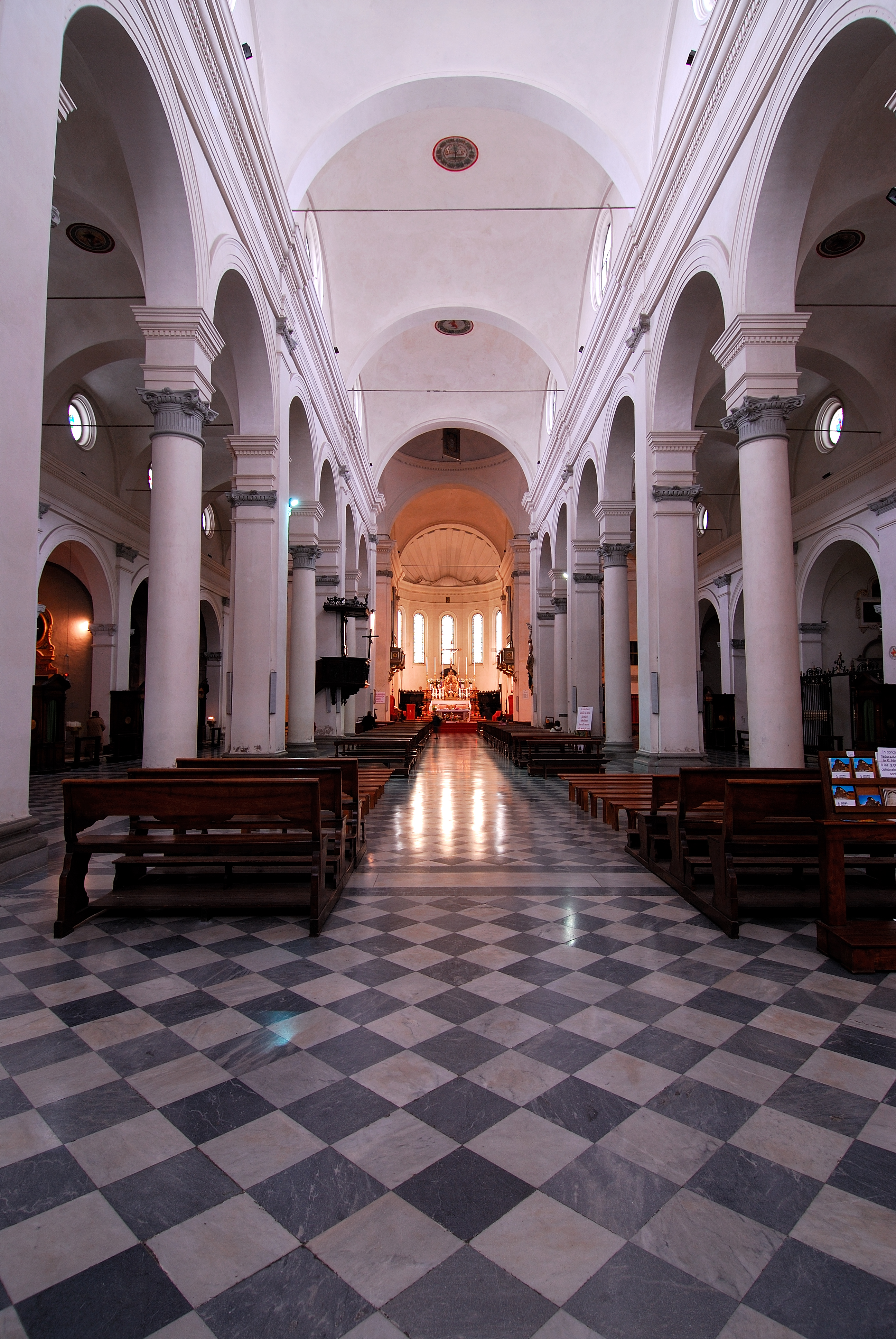
The Renaissance church stands over a previous building, commissioned by Bishop Federico Manfredi as part of the architectural and urban renewal of Faenza promoted by Lord Carlo II Manfredi. Giuliano da Maiano, a Florentine architect, was sent to Faenza by the Medici family within the framework of diplomatic and cultural relations between the two lordships.
The longitudinal plan has three naves ending in a polygonal apse with a shell-shaped vault, from the second phase of construction, housing the high altar and the 1513 wooden choir. The hemispherical dome over the short transept remains mostly in shadow, with light entering through small oculi, similarly to the Florentine San Lorenzo.
Even the façade recalls Tuscan models with its long central arched windows and articulated surface. The marble plinth is the only completed element of the cladding.
Inside, sixteen side chapels house remarkable Renaissance artworks. Highlights include the Arca di San Savino, attributed to Antonio Rossellino or Benedetto da Maiano, Biagio d’Antonio’s Christ in Pietà and Angels with Symbols of the Passion, and Innocenzo da Imola’s Blessed Virgin with Child and Saints John the Baptist, Peter and Paul, Joachim and Anne, preserved in its original gilded frame.
In the Chapel of the Madonna delle Grazie, patroness of Faenza, the miraculous image of the Virgin is preserved, a detached fresco from the church of Sant’Andrea in Vineis (today San Domenico), brought to the cathedral in 1760.
The 19th-century chapel dedicated to Saint Pier Damiani houses the relics of the Ravenna theologian who died in Faenza in 1072. Faenza Cathedral was consecrated in 1581 by Bishop Annibale Grassi.