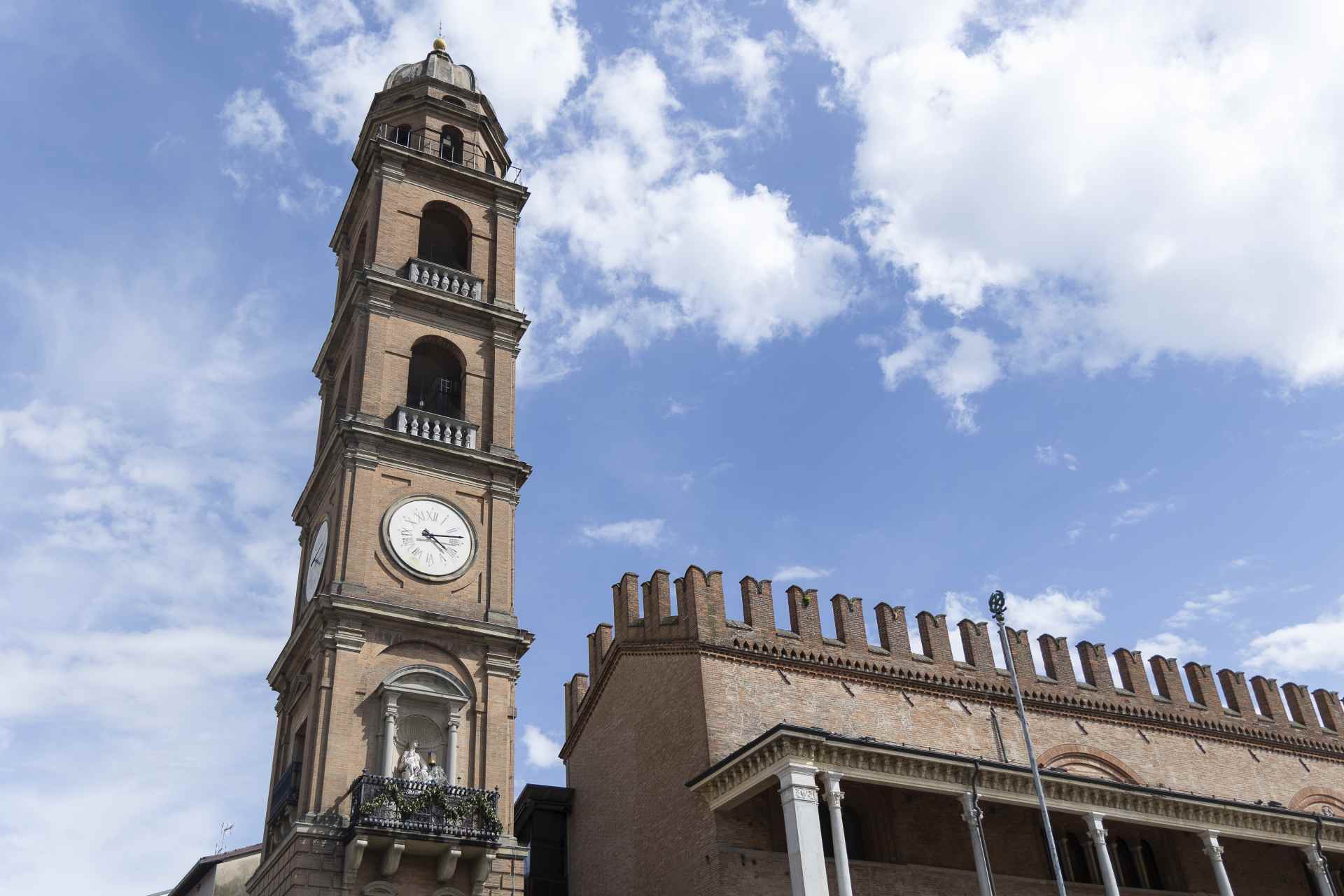
The square stands at the centre of the Roman Faeventia, along the ancient Via Emilia, at the intersection of the cardo and the decumanus, whose layout is still traced by the modern streets.
The square took shape in the medieval period, with the development of the communal institutions and the construction of the Palazzo del Podestà in the 12th century and the Palazzo del Popolo in the 13th century, facing each other to define the space.
In 1377 Astorgio I Manfredi seized power over the city, settling in the Palazzo del Popolo, which became the Manfredi residence, and transforming the communal government into a lordship.
At ground level, the palaces housed shops and market stalls, and the square was, as it still is today, the site of the city market. In the 14th century commercial activities were sheltered by the construction of wooden porticoes, which gave rise to the new appearance of the square.
Around 1470, the construction of the double loggia of Palazzo Manfredi began under Carlo II, an element that enhanced the prestige of the building and became the defining architectural feature of the square. The first porticoed structure extended as far as the Voltone della Molinella and was only continued and later replicated in the following centuries, including during the nineteenth-century reconstructions.
The palace featured a garden and two courtyards; the Molinella courtyard, which still exists today, was directly connected to the public space. The noble floor housed the representative rooms, the private apartments of the Manfredi family and the court. Very little of the Renaissance layout survives, due to alterations made between the 18th and 19th centuries.
The entire loggia was later rebuilt by the municipal engineer Ignazio Bosi between 1859 and 1860, in forms similar to the original but simplified compared to the Renaissance design.
The double loggia of Palazzo del Podestà dates instead to the years 1759–1763, during the height of Faenza’s Neoclassical period. The original project envisaged a single storey, but the Council of Elders opted for a double volume to achieve symmetry with the loggia of the Manfredi palace, whose forms architects G.B. Campidori and G.B. Boschi also intended to replicate.
This loggia too underwent renovations starting in 1872–1875 under the direction of Achille Ubaldini, who adopted classical forms inspired by those of the town hall. Due to further conservation issues, the loggia was again modified in the 1930s, with the consolidation of the portico and the rebuilding of the loggia.
The passing centuries and the different design phases have not compromised the unified conception of the square, which since the late communal period has acquired its present appearance, in a form where public space engages in dialogue with the surrounding buildings, according to a Renaissance sense of proportion.

Clock Tower
At the end of the loggia rises the Clock Tower, originally connected to the Palazzo del Podestà by the final bay of the portico. The original tower, built in the 17th century, was blown up by the retreating German army in 1944. The explosion also damaged the last bay of the loggia of Palazzo del Podestà. The reconstruction of the tower, in forms close to the seventeenth-century original, dates to 1953.
In the niche facing the square stands the marble statue from 1611 by Francesco Scala, depicting the Madonna and Child. Every year in May the city celebrates the “Fiorita dei bambini”, placing the traditional flower garland at the foot of the statue on the occasion of the feast of the Blessed Virgin of Grace, patron saint of Faenza.